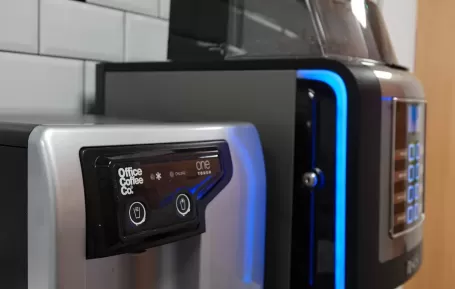
If you’re weighing up bean-to-cup vs pod coffee machines, you’re not just choosing how coffee is made. You’re deciding how workplace coffee supports productivity, employee experience and long-term cost control.
For facilities managers, office managers, HR teams and procurement decision-makers, the question is practical: which system performs reliably in shared office spaces, hybrid working environments and growing businesses?
This guide compares bean-to-cup and pod machines through a workplace lens, covering cost, scalability, sustainability and servicing.
If you’re exploring options, you can also review our range of office coffee machines designed specifically for modern workplaces.
What’s the Difference Between Bean-to-Cup and Pod Coffee Machines?
Understanding how each system works helps explain why performance differs at scale.
Bean-to-cup coffee machines
A bean-to-cup machine grinds whole coffee beans fresh for every drink. The system automatically doses, extracts and delivers espresso-based drinks with minimal manual input.
In workplace environments, this typically means:
- Freshly ground coffee per cup
- Consistent flavour across multiple users
- Lower packaging waste compared to capsules
- Better suitability for 50 or 100+ daily users
Fresh grinding improves aroma and body. In offices where coffee is part of the daily rhythm, that consistency shapes employee satisfaction and shared space usage.
Pod coffee machines
Pod machines use sealed capsules containing pre-ground coffee. The machine pierces the capsule and forces water through it.
They are simple to operate and require minimal calibration. However, in busy workplaces they also involve:
- Higher cost per cup
- Ongoing capsule supply dependency
- Increased packaging waste
- Frequent restocking in high-footfall environments
In small teams, this may be manageable. In larger shared office spaces, operational friction becomes more noticeable.
Is Bean-to-Cup Better Than Pods for Offices?
This is one of the most common questions we get asked: is bean-to-cup better than pods?
In most medium and large workplaces, yes. And the reasons extend beyond taste.
Taste and drink quality
Bean-to-cup systems grind fresh beans for every drink, which improves flavour depth and aroma. According to the British Coffee Association, coffee freshness significantly affects extraction and flavour profile.
Pods can produce consistent results, but pre-ground coffee sealed in capsules cannot replicate the freshness of whole beans.
In practical terms, better-tasting coffee reduces external coffee spend and encourages staff to remain on site.
Performance at scale
Hybrid working environments create unpredictable demand spikes. Morning peaks, meeting breaks and collaborative sessions put pressure on equipment.
Bean-to-cup systems are typically better suited to:
- Reliable performance at peak times
- Consistent extraction across users
- Scalability as teams grow
- Multi-site business consistency
Pods can suit very small offices, but in medium to large environments they often require constant monitoring and restocking.
Workplace experience
Coffee contributes to workplace culture. It encourages natural breaks, informal conversations and shared routines.
Research from the International Coffee Organization highlights coffee’s role in daily social interaction across working environments.
When deciding what is better, coffee beans or pods, consider the impact on:
- Employee wellbeing
- Staff retention
- Shared office space engagement
- Office attendance
For most businesses beyond very low usage, bean-to-cup supports a stronger long-term business coffee solution.
Cost Comparison: Upfront Price vs Total Cost of Ownership
Cost comparisons often focus on equipment price. That rarely reflects long-term reality.
Upfront investment
Pod machines generally cost less to purchase. Bean-to-cup machines often require a higher initial investment.
For procurement and finance stakeholders, the more important metric is total cost of ownership.
Cost per cup
Pods involve individual capsules for each drink, which typically increases cost per serving. Whole coffee beans purchased in bulk often reduce per-cup costs at higher usage levels.
For example:
- Small teams under 20 may not see significant difference
- Offices of 50 or more usually do
- High-volume workplaces can see substantial annual variation
Hidden operational costs
Beyond coffee itself, consider:
- Time spent restocking capsules
- Waste management requirements
- Downtime impact
- Reduced productivity when staff leave for better coffee
Facilities managers often find that preventative maintenance and contracted support for bean-to-cup systems provide better cost predictability.
If you’re evaluating long-term investment, you may also want to explore our coffee machines for business to compare commercial-grade performance options.

Which Works Best for 20, 50 or 100+ Employees?
Matching machine type to staff size is one of the clearest decision drivers.
Up to 20 staff
Pods may work in low-volume offices with minimal daily usage. Growth plans should be considered early to avoid replacement costs later.
20 to 50 staff
At this scale, demand becomes less predictable. Bean-to-cup systems typically provide:
- Better reliability at peak times
- Lower per-cup costs over time
- Reduced packaging waste
- Improved consistency across users
100+ staff
In high-footfall environments, reliability and continuity matter most.
A coffee machine for 100 employees must:
- Handle sustained daily demand
- Maintain consistent drink quality
- Support business continuity
- Scale across multi-site businesses
Bean-to-cup systems are generally better suited to this level of operational pressure.
Maintenance, Servicing and Downtime
Servicing isn’t a minor detail. It affects business continuity.
Do bean-to-cup machines need servicing?
Yes. Like any commercial equipment, they benefit from preventative maintenance to maintain performance and extend lifespan.
With structured service coverage, this becomes routine rather than reactive.
Are pod machines easier?
Mechanically, pods are simpler. However, daily management still involves restocking and waste handling.
Facilities managers should evaluate:
- UK-based support
- Defined response times
- In-house engineers
- Contracted service coverage
Reliable servicing reduces downtime, protects productivity and simplifies supplier management.
Sustainability and Ethical Impact
Sustainability plays a growing role in business coffee machine procurement.
Packaging waste
Pods generate individual capsule waste. While some capsules can be recycled, UK recycling rates vary by material and scheme.
Bean-to-cup systems use larger packaging formats, which generally reduces single-use waste at scale.
Ethical sourcing
Businesses increasingly look for Fairtrade certification and transparent supply chains.
Bean-to-cup systems allow greater flexibility in selecting ethically sourced coffee, including rainforest-supporting initiatives such as those backed by the World Land Trust.
Sustainable workplace coffee can form part of broader ESG commitments and responsible procurement policies. At Office Coffee we believe that you can protect our rainforests by drinking ethical coffee, which is why our Fairtrade, organic Puro Coffee helps to support local communities with the World Land Trust.
So What’s the Right Choice for Your Business?
While there’s no universal answer, there is a practical framework you can follow.
Choose based on:
- Team size and cups per day
- Hybrid working patterns
- Peak-time demand
- Long-term cost structure
- Sustainability priorities
- Service and support expectations
Pods can suit very small, low-use teams.
For most medium and large workplaces, bean-to-cup delivers stronger performance across quality, cost control, scalability and employee experience.
If you’d like tailored advice, you can contact our team for guidance based on your workplace size and usage.

FAQs
1. How do I know if our office is big enough for bean-to-cup?
If your team regularly exceeds 20 daily users or experiences peak-time demand, bean-to-cup is usually worth considering. It handles higher volume more reliably and reduces long-term per-cup costs.
2. Will switching from pods disrupt our team?
Most modern bean-to-cup machines are intuitive and require minimal training. Staff typically adapt quickly, especially when drink quality improves.
3. What if our office attendance fluctuates?
Hybrid patterns make scalability important. Bean-to-cup systems generally cope better with unpredictable peaks than pod machines designed for lighter use.
4. Are bean-to-cup machines noisy in office kitchens?
Modern commercial bean-to-cup machines are designed for shared environments. While grinding creates brief sound, it’s typically comparable to other standard office equipment.
5. Do bean-to-cup machines use more electricity?
Energy usage depends on model and volume. In higher-demand settings, energy per cup is often efficient relative to capsule production and disposal impacts.
6. How often should a workplace coffee machine be serviced?
Most commercial machines benefit from preventative servicing every six to twelve months, depending on usage. Regular maintenance reduces breakdown risk.
7. Is good coffee really an employee perk?
Yes. Quality workplace coffee supports employee wellbeing, encourages collaboration and reduces external spend. It’s a visible signal that staff experience matters.
8. Can bean-to-cup machines work in multi-site businesses?
Yes. Standardised bean-to-cup systems help maintain consistent drink quality across locations and simplify supplier management.
9. What should facilities managers prioritise?
Facilities managers should focus on reliability at volume, defined response times, preventative maintenance and long-term cost control.
10. Is sustainability only about waste reduction?
No. Ethical sourcing, Fairtrade certification and rainforest conservation partnerships are equally important considerations in responsible coffee procurement.